

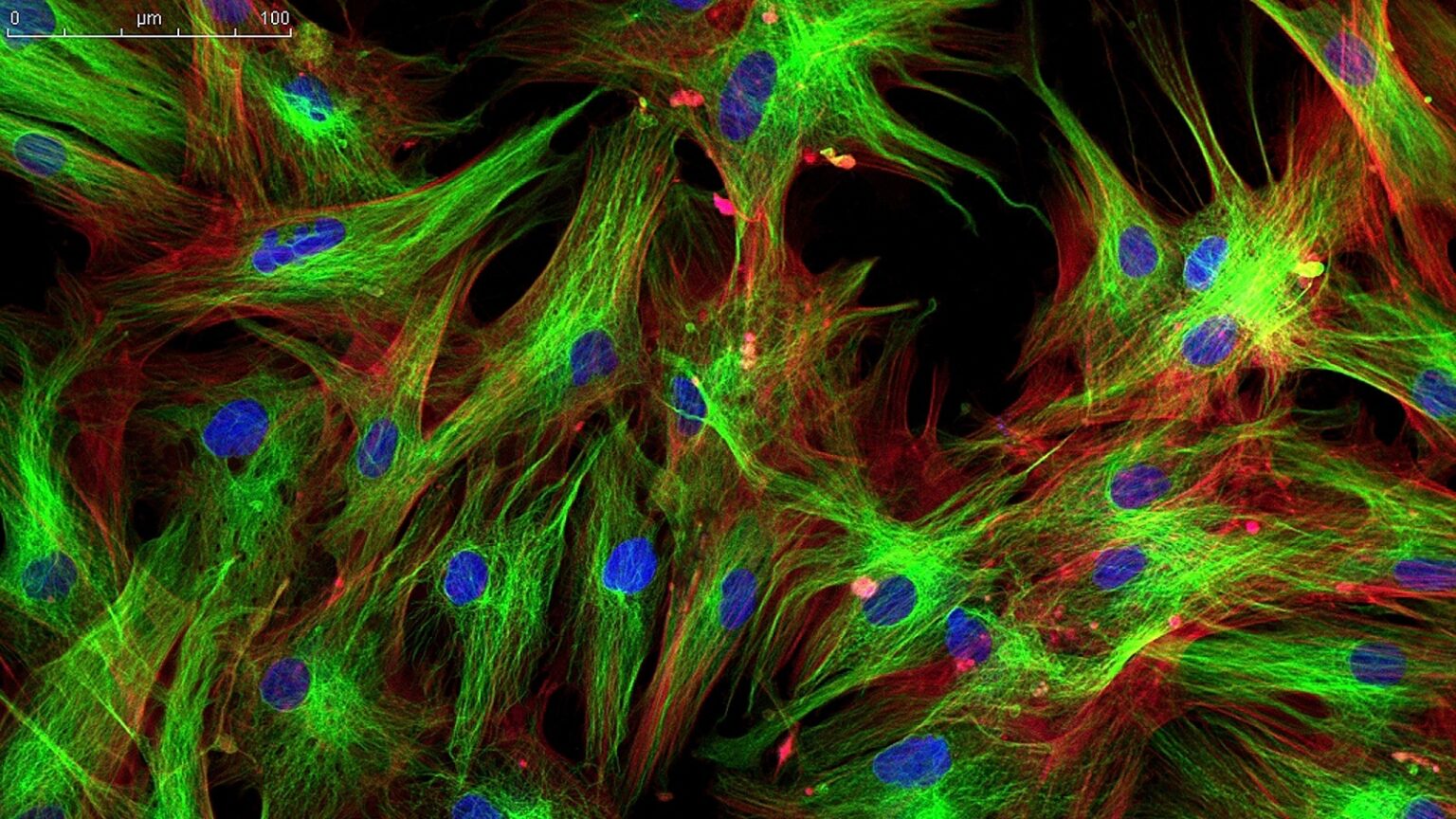

The CRI’s cell and tissue imaging platform (IMA’CRI) provides research teams with state-of-the-art microscopy equipment and techniques. Its main objective is to provide research groups inside and outside the center with complementary imaging approaches to study organelles, cells and tissues in normal and pathological states at different scales.
Imaging with fluorescence optical microscopy has become an essential method for biological research, and particularly for medical research. Recent technological advances have led to the development of faster, higher-resolution microscopes for collecting three-dimensional images of living biological samples.
The aim of the imaging platform is to provide cutting-edge technologies and expertise in light microscopy to both in-house and external teams.
The equipment is equipped with a suitable incubator to maintain organisms in physiological conditions by controlling temperature and CO2 levels.
All users can benefit, if required, from theoretical and practical training in the use of photonic microscopes (wide-field, TIRFM, confocal, multi-photon). The aim is to pass on technical knowledge to users, so that they can operate the equipment independently.
The engineer also helps to analyze results and images.
The platform is responsible for technical maintenance and technology watch, to ensure that the equipment is running smoothly on a daily basis, to plan the use of microscopes, and to adapt the equipment to different experiments.
Welcome to the new head of the IMA’CRI platform, François Lanthiez, a research engineer at INSERM specializing in photonic microscopy. Its expertise is focused primarily on high-resolution imaging and image analysis, offering the possibility of precisely exploring complex structures in 2D, 3D or 4D.