

Abstract
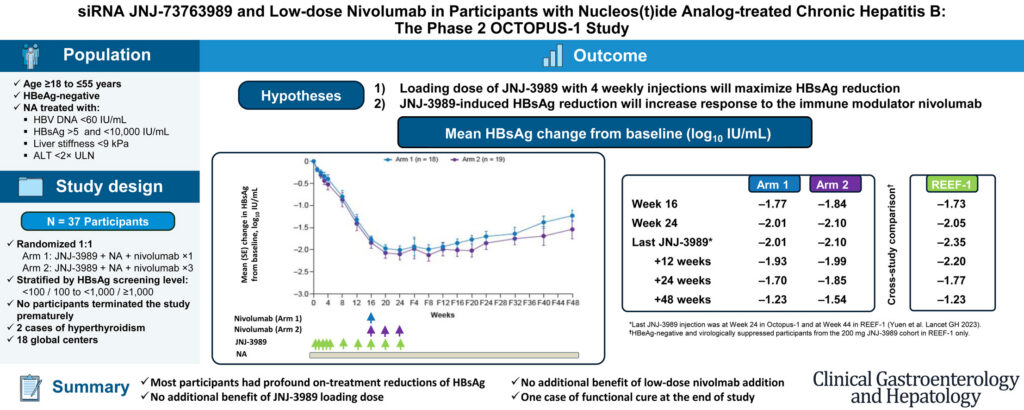
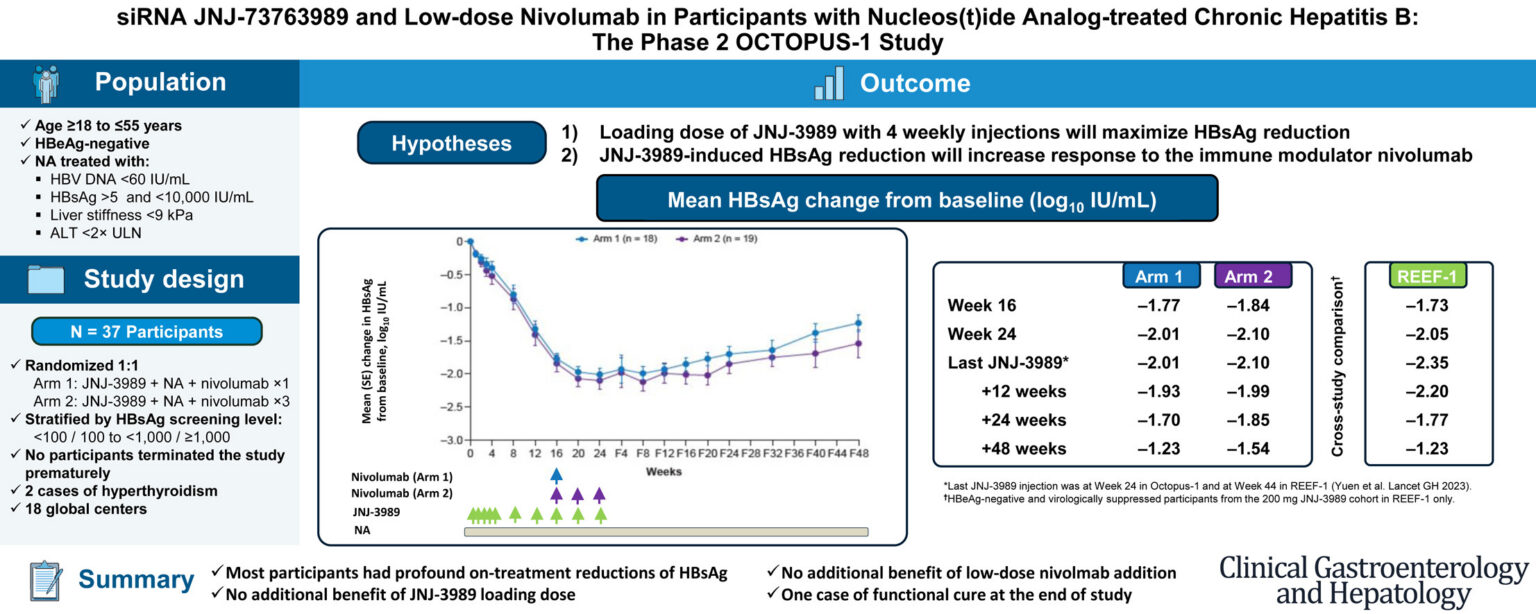
Background & aims: JNJ-73763989 (JNJ-3989)-based treatments (evaluations ongoing) reduce HBsAg in chronic hepatitis B (CHB) patients, but HBsAg seroclearance is rare. OCTOPUS-1, an open-label, randomized phase 2 study, assessed the efficacy and safety of adding low-dose nivolumab (PD-1 inhibitor) to JNJ-3989+nucleos(t)ide analog (NA).
Methods: HBeAg-negative, virologically suppressed CHB participants received JNJ-3989 loading dose (200mg once weekly) for 4 weeks then every 4 weeks (Q4W) until Week 24 (W24) with daily NA. Nivolumab (0.3mg/kg) was administered at W16 for Arm 1 and at W16, W20, and W24 for Arm 2; both arms had 48-week follow-ups (FUW48).
Results: Thirty-seven participants were enrolled (Arm 1: 18; Arm 2: 19); all completed the study. None achieved the primary endpoint of HBsAg seroclearance at FUW24, but 1 (Arm 2) achieved HBsAg seroclearance at FUW48. Both arms had robust mean [SE] HBsAg changes from baseline before nivolumab administration (Arm 1: -1.32[0.12]; Arm 2: -1.41[0.16]log10IU/mL), at W24 (Arm 1: -2.01[0.09]; Arm 2: -2.10[0.13]log10IU/mL), and at FUW48 (Arm 1: -1.23[0.13]; Arm 2: -1.54[0.21]log10IU/mL). The mean receptor occupancy (determined 2 hours post-infusion at W16) was ≥70% and ≥90% in Arms 1 and 2 with no clear association between HBV-specific T-cells and HBsAg. No serious adverse events (AEs), grade 3/4 AEs, or AEs leading to discontinuation were reported; 2 participants experienced asymptomatic transient hyperthyroidism. Cross-study analysis with REEF-1 (virologically suppressed, HBeAg-negative participants) revealed no additional benefit of loading dose or nivolumab.
Conclusions: JNJ-3989+NA+nivolumab treatment was generally safe and led to robust HBsAg declines; no HBsAg seroclearance was observed.