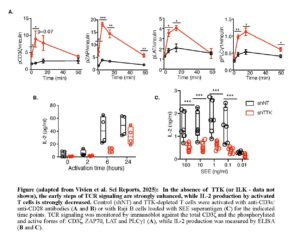



T cell activation is essential for adaptive immunity, helping to protect the body against infections and tumors. A key step in this activation is signal transduction downstream of the T lymphocyte antigen receptor. This signaling involves several steps. This signaling involves several steps, the first of which take place at the plasma membrane and others later, after TCR internalization. The later stages of TCR signaling remain poorly understood. Since the TCR can signal after internalization, we postulated that kinases abundantly expressed in T cells could regulate TCR signaling. This study focuses on two such enzymes: integrin-linked kinase (ILK) and threonine-tyrosine kinase (TTK), whose involvement in TCR signaling has not been previously investigated. Using specific depletion of TTK and ILK by lentiviral shRNA, we show that in the absence of ILK and TTK, the early steps of TCR signaling are strongly enhanced, while IL-2 production by activated T cells is strongly diminished. These results are relevant because TTK and ILK are important targets in oncology, and our findings show that their inhibition affects the activation of T cells, which play an essential role in anti-tumor defense.