

Abstract
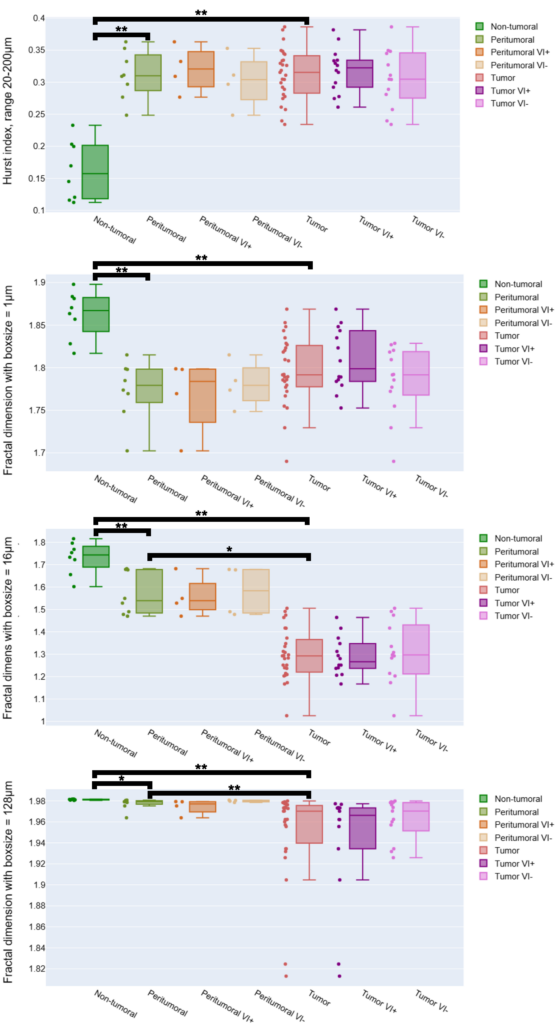
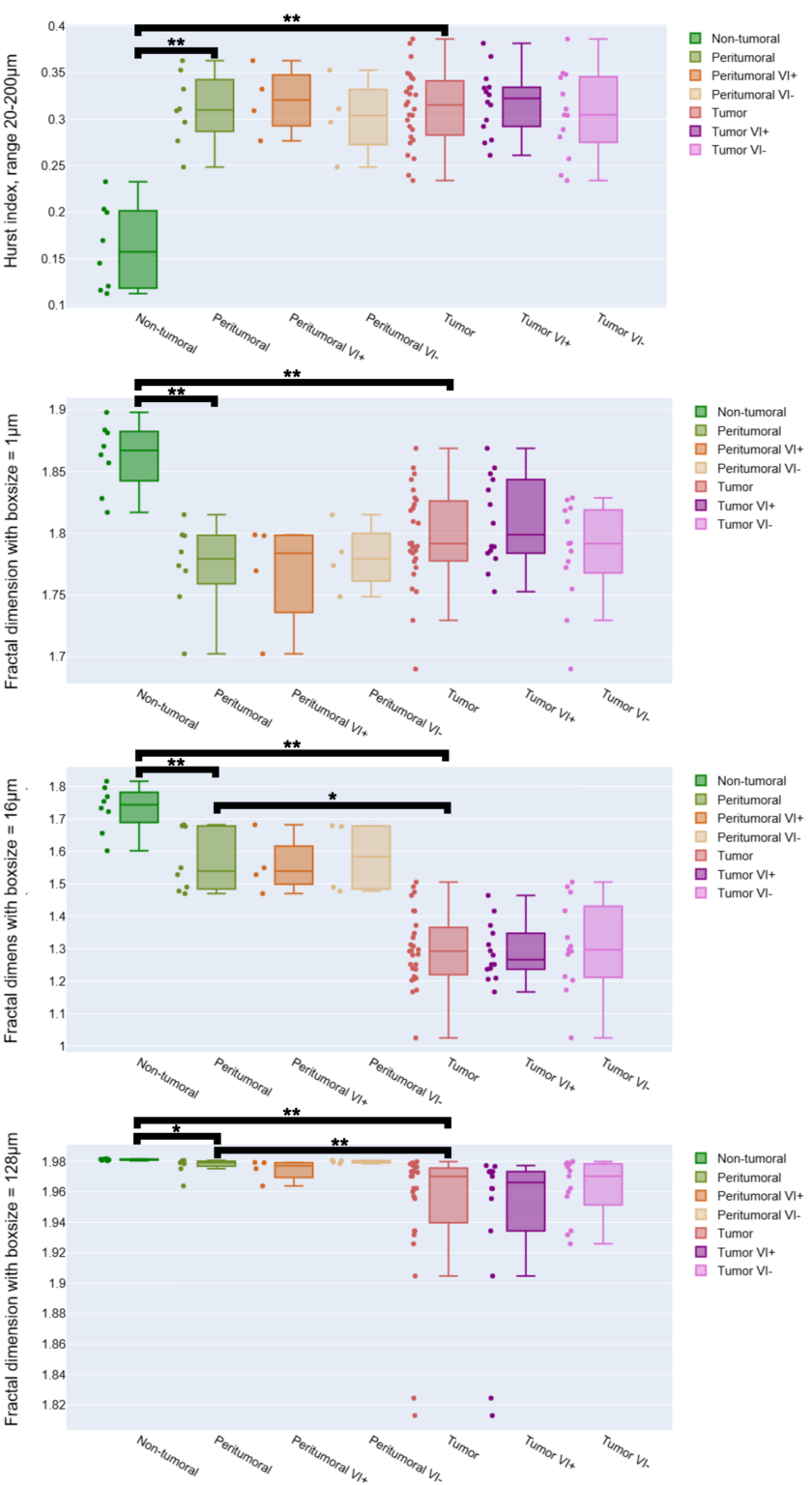
Tumor vasculature architecture influences treatment response, particularly in hepatocellular carcinoma (HCC) where anti-angiogenic therapies are standard. Although CD31 is a positive endothelial stain, classical CD31-derived metrics –such as vessel density or area fraction–primarily quantify vascular abundance and provide limited insight into organization. These metrics cannot reliably separate vascular phenotypes across tissue regions when organization, rather than quantity, is the discriminating feature. To address this gap, we investigated whether mathematical, scale-dependent descriptors could distinguish vascular organization beyond what classical metrics capture. Here, fractal dimension and Hurst index were derived on vessels segmented from 29 CD31-stained HCC samples across tumoral, peri-tumoral, and distant non-tumoral regions, with/without vascular invasion–a key prognostic indicator. Statistically significant differences (p<0.01) in fractal dimension were observed between the three regions between 16 – 128µm box size, whereas extremal scales showed no differences. The Hurst index exhibited similar differences emerging within the 20 – 200µm range. This fractal disparity reflects underlying differences in vessel-shape distributions, with tumoral regions containing fewer small, round vessels than non-tumorous tissue. Conversely, vascular invasion did not yield significant differences (p>0.1). These findings demonstrate robust regional differences in vascular organization in HCCs, supporting future studies investigating vascular fractality through non-invasive imaging approaches.