


Abstract
Purpose: The choice of adjuvant chemotherapy in pancreatic ductal adenocarcinoma (PDAC) is mainly guided by patients’ general condition. We hypothesized that tumor morphology may predict differential treatment benefit and tested whether deep learning applied to histology images could derive a biomarker of relative benefit from gemcitabine (GEM) versus modified FOLFIRINOX (mFOLFIRINOX) in resected PDAC.
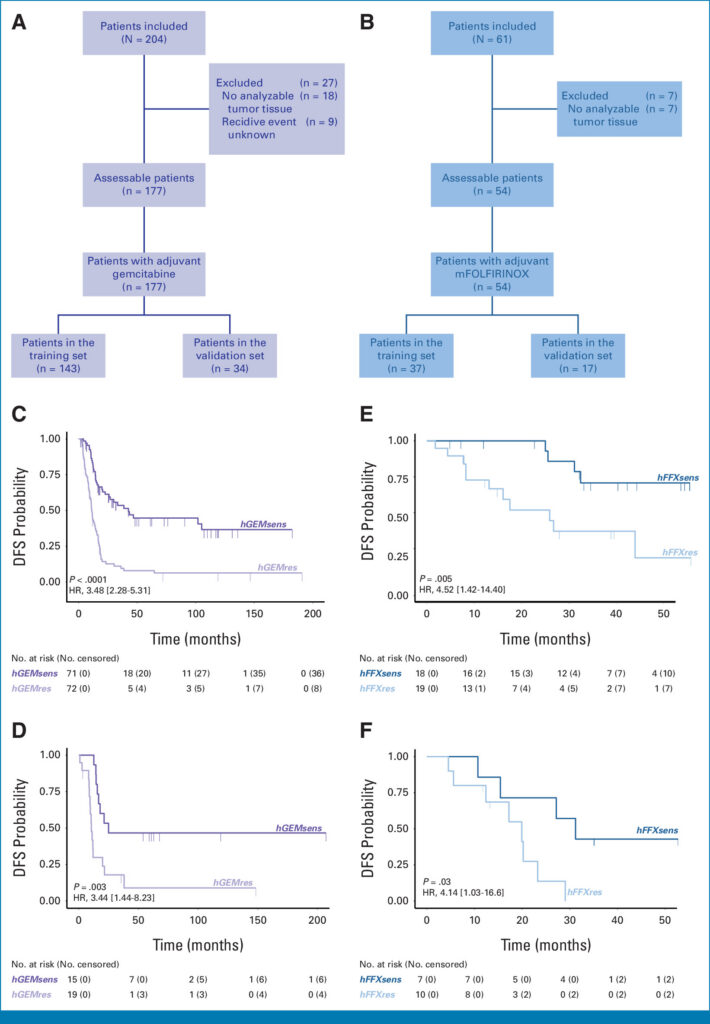
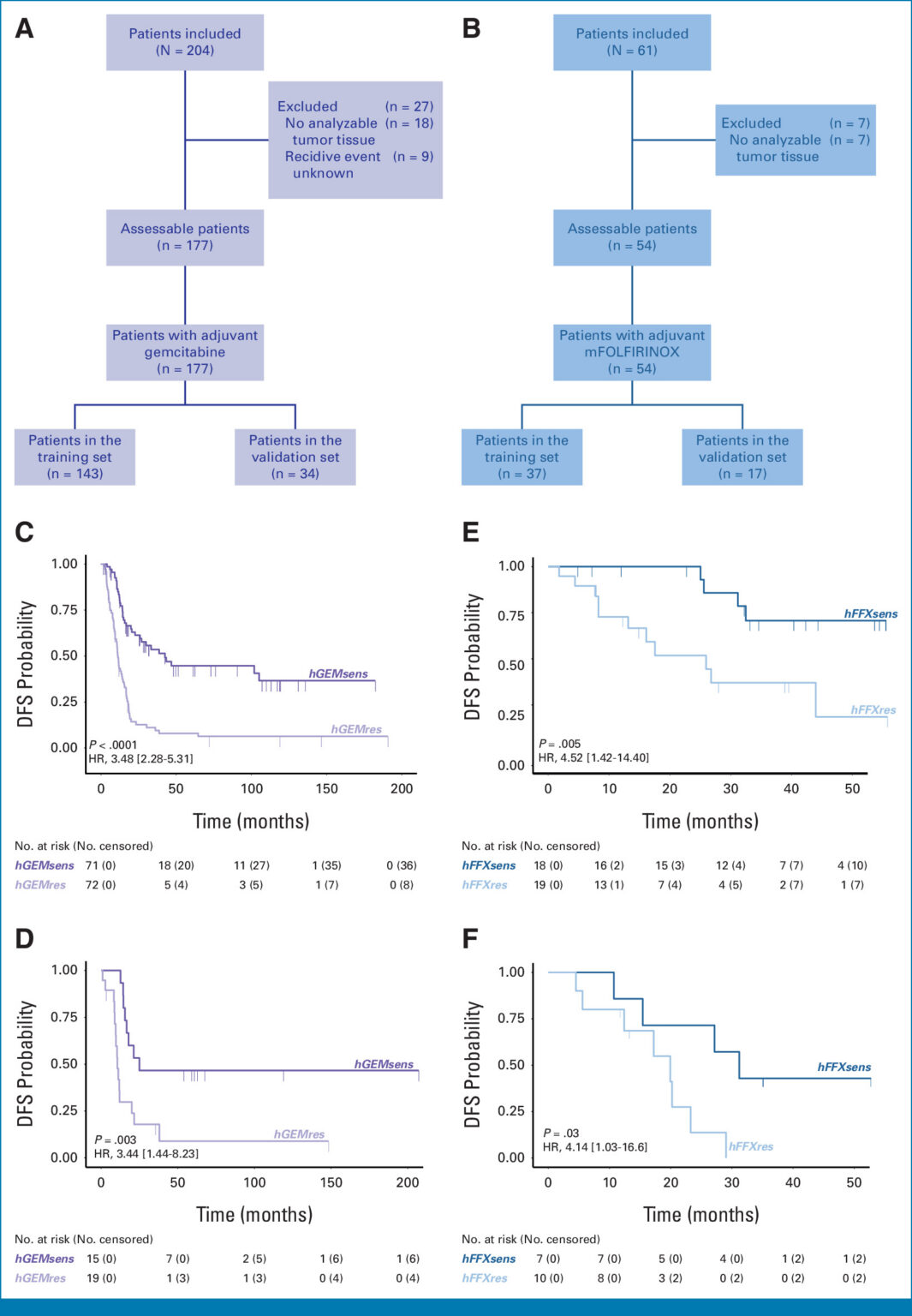
Patients and methods: Standard whole-slide images from a retrospective multicentric series of 231 patients who underwent curative-intent pancreatectomy and received adjuvant mFOLFIRINOX (n = 54) or GEM (n = 177) were used to train regimen-specific histology models on disease-free survival (DFS), which were then combined into PANCprAId, a biomarker estimating personalized relative benefit from adjuvant GEM versus mFOLFIRINOX. External validation was performed in the randomized PRODIGE-24/CCTG PA6 trial (n = 313).
Results: In PRODIGE-24/CCTG PA6, the treatment-specific histology scores used to construct PANCprAId stratified outcomes among patients treated with GEM (hazard ratio [HR], 1.69 [95% CI, 1.04 to 2.73]; P = .03) and mFOLFIRINOX (HR, 2.02 [95% CI, 1.4 to 3.0]; P < .001). When combined into PANCprAId, the biomarker identified subgroups with differential relative benefit from adjuvant GEM versus mFOLFIRINOX, with significant treatment interactions for DFS (interaction P = .003) and cancer-specific survival (interaction P = .001). Predicted sensitivity to each regimen was associated with distinct epithelial and stromal features.
Conclusion: Histology-based deep learning can derive a predictive biomarker of relative benefit from adjuvant GEM versus mFOLFIRINOX in resected PDAC.