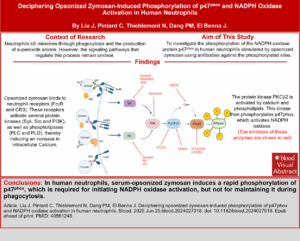
Neutrophils play a key role in innate immunity by eliminating microbes through phagocytosis and superoxide anion production via the phagocyte NADPH oxidase. The signaling pathways regulating activation of this oxidase in neutrophils have been extensively studied using soluble agonists, but are less well understood during phagocytosis, a fundamental function of neutrophils.
The aim of this study was to examine phosphorylation of the cytosolic NADPH oxidase protein p47phox in human neutrophils stimulated with serum-opsonized zymosan (OZ), which induces phagocytosis, using antibodies directed against phosphorylated sites. The results show that OZ induces rapid phosphorylation of p47phox at residues Ser304, Ser315, Ser320 and Ser328, followed by equally rapid dephosphorylation.
Interestingly, despite the transient nature of this phosphorylation, OZ-induced NADPH oxidase activity remained sustained for longer, both in intact cells and in isolated membranes. OZ-induced phosphorylation of p47phox at these sites was concentration-dependent and preceded particle ingestion.
Zymosan opsonized with IgG or C3bi also induced rapid phosphorylation and dephosphorylation of p47phox at residues Ser304, Ser315, Ser320 and Ser328, suggesting the involvement of FcγR and CR3 receptors in this process.
Inhibitors of Src and Syk tyrosine kinases, PI3K, PLC, PLD, calcium (Ca++) and PKCβ2 inhibited OZ-induced phosphorylation of p47phox at these residues.
These results suggest that :
OZ-induced phosphorylation of p47phox at residues Ser304, Ser315, Ser320 and Ser328 is required to initiate NADPH oxidase activation, but not for its maintenance during phagocytosis;
membrane receptors FcγR and CR3 are involved in this phosphorylation;
les kinases Src et Syk, la PI3K, la PLD, le calcium et la PKCβ2 contrôlent la phosphorylation de p47phox au cours de la phagocytose.
Neutrophils play a key role in innate immunity by eliminating microbes through phagocytosis and superoxide anion production via the phagocyte NADPH oxidase. The signaling pathways regulating activation of this oxidase in neutrophils have been extensively studied using soluble agonists, but are less well understood during phagocytosis, a fundamental function of neutrophils.
The aim of this study was to examine phosphorylation of the cytosolic NADPH oxidase protein p47phox in human neutrophils stimulated with serum-opsonized zymosan (OZ), which induces phagocytosis, using antibodies directed against phosphorylated sites. The results show that OZ induces rapid phosphorylation of p47phox at residues Ser304, Ser315, Ser320 and Ser328, followed by equally rapid dephosphorylation.
Interestingly, despite the transient nature of this phosphorylation, OZ-induced NADPH oxidase activity remained sustained for longer, both in intact cells and in isolated membranes. OZ-induced phosphorylation of p47phox at these sites was concentration-dependent and preceded particle ingestion.
Zymosan opsonized with IgG or C3bi also induced rapid phosphorylation and dephosphorylation of p47phox at residues Ser304, Ser315, Ser320 and Ser328, suggesting the involvement of FcγR and CR3 receptors in this process.
Inhibitors of Src and Syk tyrosine kinases, PI3K, PLC, PLD, calcium (Ca++) and PKCβ2 inhibited OZ-induced phosphorylation of p47phox at these residues.
These results suggest that :
OZ-induced phosphorylation of p47phox at residues Ser304, Ser315, Ser320 and Ser328 is required to initiate NADPH oxidase activation, but not for its maintenance during phagocytosis;
membrane receptors FcγR and CR3 are involved in this phosphorylation;
les kinases Src et Syk, la PI3K, la PLD, le calcium et la PKCβ2 contrôlent la phosphorylation de p47phox au cours de la phagocytose.
The CRI has recently undergone changes with the arrival and departure of certain teams. The content of our website is currently being updated. Some information may be outdated at the moment but will be corrected shortly.
We apologize for any inconvenience caused.
The Cellcom Team.
Event pages under repair
Hello,
The various calendars of events are currently experiencing a malfunction.
This impacts calendars, but also links, images and forms.
A solution is currently in progress.
Thank you for your patience and we apologize for the inconvenience caused.
In the meantime, please refer to our social networks to access additional information.
The link on this page is protected and only accessible to CRI staff.
The password is that of the main intranet.
Cordially
Problème Convention stage
Hello,
We have problems in the management of internship agreements this year.
Two reasons are at the origin of this dysfunction
– the change of the name of the DR which obliges us to resume all the files transmitted
– the number of interlocutors in the internal circuit
In order to facilitate this process, we suggest that you use ONLY the address stages.u1149@inserm.fr for any communication or request concerning your requests and follow-up of internships.
Each team leader has the opportunity to follow the progress of the processing of their team’s internship requests.
The internship monitoring table will allow the team leader to monitor the processing of his interns’ files.
The CRI internship office is open to the public Tuesday and Thursday from 9:00 a.m. to 12:00 p.m. then from 1:00 p.m. to 3:00 p.m.
Information site Web
Update 02/08/2021
Changes made over the weekend have significantly improved the speed of the website.
Other changes will be made during the week to further optimize the speed of the site.
These changes should not lead to maintenance periods, except unexpected exceptions .
The technical team of the site thanks you for your understanding.
Rappel de produit Fils soie vierge JohnsonJohnson
ETHICON is initiating a recall of certain codes and lots of 8-0 blue twisted Virgin Silk suture.
Some lots may not strictly meet individual and average tensile strength requirements during the entire shelf life. Thus, ETHICON cannot maintain a shelf life of 5 years.