

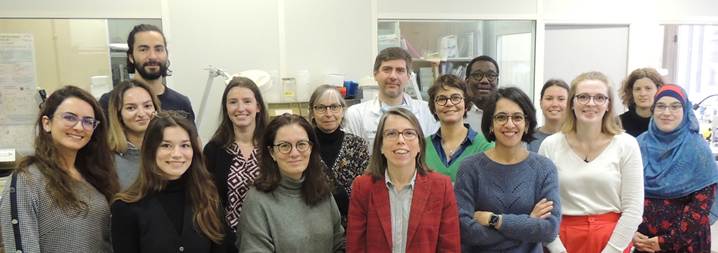
Team composition
Our team is interested in the contribution of the gastrointestinal tract to nutritional disorders, ranging from overnutrition (obesity) to undernutrition (intestinal failure). Obesity is most often associated with comorbidities such as type 2 diabetes or non-alcoholic fatty liver disease, and pharmacotherapy for this condition remains inconsistently effective. Currently, bariatric surgery, which involves remodeling the gastrointestinal tract, is the only effective treatment for maintaining long-term weight loss. While these surgeries are generally extremely beneficial, we have reported that they can sometimes lead to intestinal failure, with severe malnutrition, microvesicular steatosis, and acute liver failure (Lancet 2013 and Lancet Gastroenterol Hepatol 2021). This situation is reminiscent of short bowel syndrome (SBS), which results from extensive resection of the small intestine and is the leading cause of intestinal failure.
The human and social cost The economic impact of these nutritional disorders is constantly increasing. Their management therefore requires research efforts to better understand their pathophysiological mechanisms in order to identify new therapeutic targets and strategies.
To address this societal need, our team has brought together scientists specializing in the physiology of the gastrointestinal tract and clinicians (gastroenterologists, digestive surgeons, and nutritionists). Together, we are studying the mechanisms of gastrointestinal adaptations in response to obesity, undernutrition/malnutrition, and surgical reconfiguration of the gastrointestinal tract.
We have developed murine models of bariatric surgeries: vertical sleeve gastrectomy (VSG), Roux-en-Y gastric bypass (RYGB) (PLoS One 2015, Gastroenterology 2016), and single-anastomosis gastric bypass (OAGB). href=”https://www.ncbi.nlm.nih.gov/pubmed/27418681″>Am J Physiol 2016) and more recently sleeve gastrectomy with transit bipartition (SGBT) (Obesity Surgery 2023) as well as models summarizing short bowel syndrome (Sci. Rep. 2016, Front Cell Infect Microbiol. 2023).
By combining experimental research in these preclinical models and clinical studies, we identified differences in intestinal adaptation contributing to improved glucose homeostasis after RYGB versus VSG bariatric surgeries (Gastroenterology 2016, Nature Commun 2021). In parallel, we characterized the structural and functional adaptations of the residual intestinal mucosa and microbiota in humans and rats with short bowel syndrome (Sci. Rep. 2016, Microorganisms 2016, Front. Physiol. 2017, Front Cell Infect Microbiol. 2023).
In all these studies, we highlighted the plasticity of the epithelial cells constituting the gastrointestinal mucosa and its consequences on intestinal functions (Trends Endocrinol Metab. 2017, Nutr Rev. 2019, Annu. Rev. Nutr. 2020).
Intestinal reprogramming and improvement Changes in glucose homeostasis after bariatric surgery

The various intestinal adaptations observed after RYGB and VSG lead to improved glucose tolerance. In response to RYGB, the intestine becomes hyperplastic, the transport of dietary glucose and the absorption of blood glucose are increased, but glucose is sequestered by epithelial cells for their own use. Hyperplasia leads to an increase in the number of GLP-1 secreting cells, undoubtedly contributing to the increase in its secretion. In response to VSG, the transport capacity of dietary glucose is reduced, and a slight increase in transepithelial glucose transport from the blood to the lumen is observed. The density of GLP-1-secreting cells increases, likely contributing to the increased secretion of GLP-1.
Adapted from Cavin et al.
Gastroenterology 2016
Intestinal Adaptation in Short Bowel Syndrome

Spontaneous adaptations in short bowel syndrome are characterized by morphological (a) and functional (b) intestinal adaptations, including (a) an increase in intestinal surface area, (b) the expression of nutrient transporters and the secretion of intestinal hormones (PYY, GLP-1), (c) the development of compensatory hyperphagia, and (d) dysbiosis of the Gut microbiota.
Hyperphagia reduces dependence on parenteral nutrition by increasing net nutrient absorption. Increased enterohormones (PYY, GLP-1, GLP-2) contribute to improved energy recovery, notably through the intestinal trophic effect (GLP-2) or by slowing gastrointestinal motility (GLP-1, PYY). Dysbiosis has a putative positive effect on the production of short-chain fatty acids that fuel colonocytes.
Adapted from Le Beyec et al.
Annual Review of Nutrition 2020
We are currently extending our studies to both sides of the intestinal epithelium: the mucosal side, focusing on the analysis of immune cells, and the luminal side, focusing on the microbiota and its metabolites. (ANR iMAT AdMir and BARGAIN). Our objective is to determine the functional consequences of changes in immune cells and the microbiota on the functions of intestinal epithelial cells.
The intestinal ménage à trois: microbiota, epithelial and immune cells

Both sides of the gastrointestinal epithelium could contribute to adaptations in response to surgeries.
On the mucosal side, immune cells communicate with intestinal epithelial cells; on the luminal side, metabolites from the microbiota act as signals or nutrients for intestinal epithelial cells.
To identify new biomarkers and therapeutic targets for these pathologies, we are now developing omics studies of the intestinal mucosa and microbiota in preclinical models and, especially, in patient cohorts. For example, we have established a cohort of patients with severe obesity who are candidates for bariatric surgery. Intraoperative samples of intestine, liver, and visceral and subcutaneous adipose tissue are taken from these patients, and they are followed for at least three years: the COBILOM cohort. We also have an active patient cohort of SGC patients, allowing us to identify new predictive markers of response to the only currently available treatment, Teduglutide (Nutrients 2023, Am J Clin Nutr. 2023).
Since the long-term results of bariatric surgery vary greatly from person to person, we aim to use artificial intelligence to identify new predictive markers of surgical success or failure, and in particular of weight regain, which is very common after 2 to 3 years. To achieve this, we will use histological data from adipose tissue and the liver, two major players in metabolism, from the biobank derived from the COBILOM cohort. This will allow us to propose personalized measures to improve the long-term outcomes of bariatric surgery.