


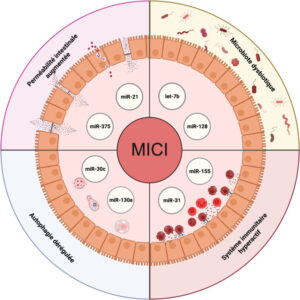
Les microARN sont de petits ARN non codants jouant un rôle clé dans le maintien de l’homéostasie en régulant environ 60 % du transcriptome humain. La sur- ou sous-expression de plusieurs microARN distincts est associée à la pathogenèse des maladies inflammatoires chroniques de l’intestin en jouant un rôle dans plusieurs fonctions clés du système digestif, telles que la fonction de barrière, l’autophagie et la communication hôte–microbiote. Les microARN sont désormais reconnus pour leur fonction possible de biomarqueurs dans le diagnostic de ces maladies, et pourraient notamment être utilisés pour différencier la MC de la RCH. Grâce à l’utilisation de modèles animaux, de nombreuses études ont exploré le rôle de microARN spécifiques dans des fonctions clés associées au développement et au maintien des maladies inflammatoires chroniques de l’intestin. Ces découvertes pourraient permettre le développement de thérapies ciblant des microARN spécifiques, dans le but de restaurer des fonctions clés de l’homéostasie intestinale. Le potentiel des microARN dans l’évaluation de la dysbiose et leur rôle en tant qu’outils de modulation du microbiote intestinal est encore largement inexploré, bien que des recherches en cours, y compris les nôtres, explorent déjà ces aspects. Cette revue vise à fournir un aperçu des implications actuellement connues des microARN dans les maladies inflammatoires chroniques de l’intestin, ainsi que leurs promesses en médecine personnalisée.
https://www.sciencedirect.com/science/article/pii/S0001407924001845?dgcid=author